
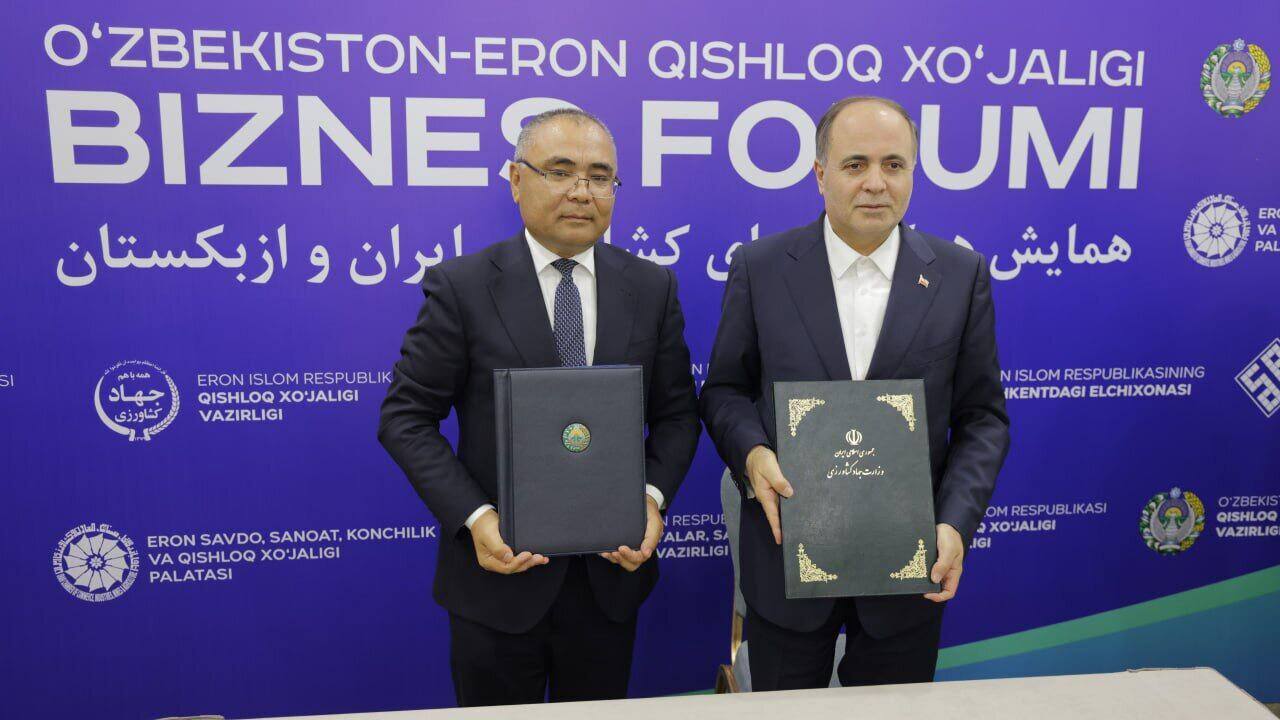
Iran and Uzbekistan are moving to turn agricultural cooperation into a technology-driven partnership, with artificial intelligence, smart irrigation and modern livestock breeding at the center of a push to expand bilateral trade to $2 billion. At a joint meeting and conference in Tehran, agriculture ministers Gholamreza Nouri Qezeljeh and Ebrahim Abdolrahmanov outlined plans to raise agricultural trade from $200 million to $600 million within two years, while broader commercial ties aim for the higher target. A trade delegation of more than 100 Iranian companies and provincial chamber leaders accompanied the talks, signaling Tehran’s intent to convert diplomatic goodwill into contracts.
The two sides emphasized joint investment in AI-based farming, livestock and pasture development. Iran presented its capabilities in mechanization, agricultural machinery, fisheries, veterinary medicines, poultry and egg production, improved cattle embryos, smart irrigation and agricultural drones. Uzbekistan, meanwhile, is reducing cotton monoculture and plans to develop 400,000 hectares of orchards, creating a large market for Iranian products. Tashkent also prioritizes next-generation agricultural equipment to improve farm productivity.
For landlocked Uzbekistan, Iran’s transport network offers access to open waters—a strategic advantage highlighted by Nouri, who also proposed a green customs corridor, barter arrangements and trade in national currencies. He called for activating joint agricultural committees and using the Iran-Eurasia free trade framework to remove barriers. Iran’s ambassador to Tashkent, Mohammad Ali Eskandari, said existing infrastructure, human resources and scientific knowledge should serve bilateral relations, while Hossein Pirmoazen, vice chairman of the Iran Chamber, said facilitation by governments must be matched by private-sector action. He noted that over 100 companies from seven provincial chambers were present and urged businesses to use a memorandum to be signed between the two chambers to define joint projects. The Iranian side also stressed the need to activate the joint agricultural cooperation committee and to make regular working-group meetings operational. Uzbek officials, for their part, pointed to Iran’s Innovation House in Tashkent as an effective platform for introducing modern achievements. They also discussed importing Uzbek agricultural products to Iran and expanding cooperation on quarantine and food-industry standards. Officials described the delegation as a sign of serious determination.
Uzbekistan’s agriculture minister praised Iran’s achievements in water management, drought combat and crop productivity, calling its innovation model inspiring for developing countries. He said Iran’s food security system has remained resilient despite economic challenges, and stressed cooperation on meat, milk and food processing. The head of Uzbekistan’s Food Safety Agency called for harmonized standards, a scientific mechanism and progress on halal standards. Both sides described food security as a priority that requires synergy and shared strengths.
The conference ended with a clear message: the potential is no longer just about buying and selling. If the agreements move from memorandums to implementation, Iran and Uzbekistan could build a regional model for technology-led agricultural trade—one that links AI, water efficiency, livestock genetics and transport corridors to the broader goal of $2 billion in commerce. The next step is implementation. The talks continue in the coming months.